Written by Gord Falconer Monday, 04 May 2009 00:00
At New Moon, the alignment of Sun, Moon and Earth isn’t perfect; the Moon usually passes above or below the Sun, although we can’t see it, owing to the Sun’s glare.
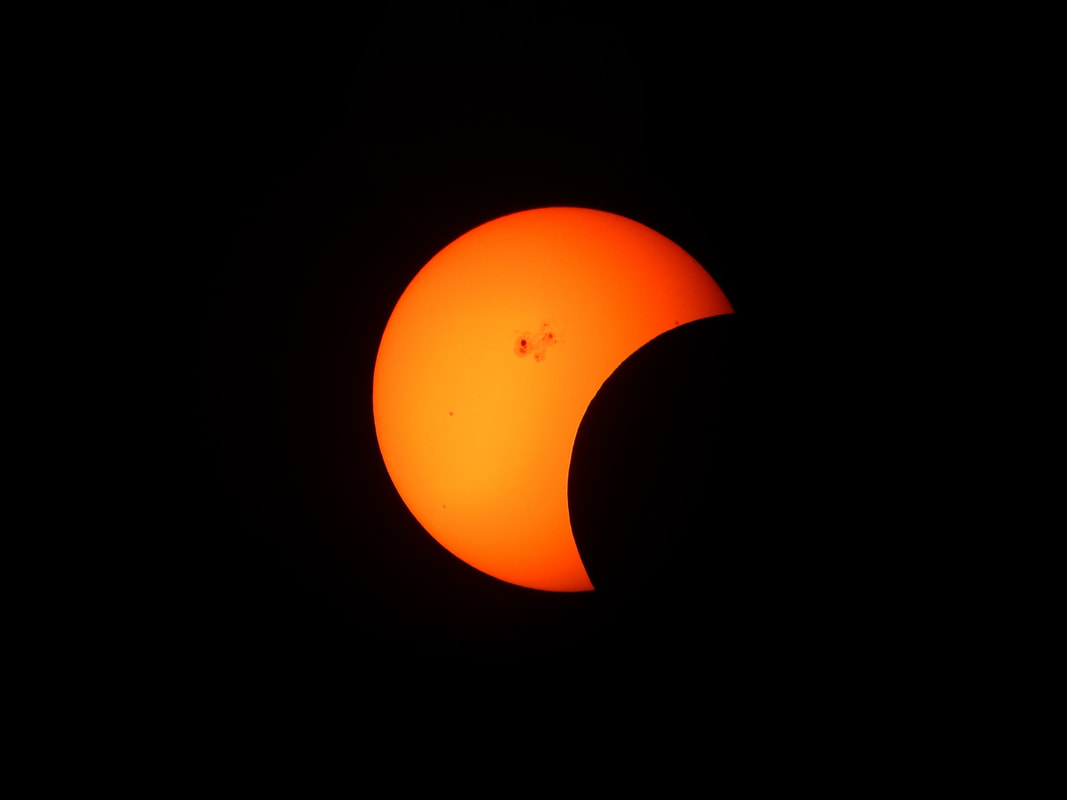
But occasionally, the Moon passes directly in front of the Sun; in effect, the Moon casts its shadow on the Earth. If you are in the shadow, you may see the Sun, with a safe solar filter, partially eclipsed; it looks as if a bite has been taken out of the Sun.
If you are lucky enough to be on the narrow strip of Earth where there is a total eclipse, the Moon completely blocks the Sun for a few minutes; the sky darkens, and the beautiful solar corona, otherwise invisible, can be seen.
These rare and beautiful events are among nature’s most awe-inspiring. Don’t miss an opportunity to see one.
Next partial solar eclipse visible from Lethbridge: May 20, 2012
Next total solar eclipse visible from Lethbridge: Aug. 23, 2044
For more informatiion:
Written by Rena Woss Sunday, 26 April 2009 00:00
Summer is around the corner and during this time of the year, astronomy clubs the world over have outdoor gatherings called Star Parties! If you have never attended, you might want consider it. It’s an opportunity to experience the splendor of the night sky with people who have a passion for it. Typically star parties are held in a dark sky site, away from light pollution. Participants bring telescopes and binoculars of all types and sizes and spend the nights observing planets, galaxies and other deep sky wonders. Larger parties offer lectures, workshops, swap meets, exhibitions, contests, tours and more. Written by Gord Falconer Monday, 13 April 2009 00:00
In some sense, Earth is just a big round rock orbiting the Sun. Like other rocks, it casts a shadow on a sunny day. Earth’s shadow is cone-shaped and projects over a million kilometers into space. Our Moon which is about 385,000 km away is well within range of Earth’s shadow. How does an eclipse occur? During a Full Moon, the Moon usually passes above or below the shadow; but sometimes, it passes partially or directly into the path of Earth’s shadow. When this alignment occurs, we call it a lunar eclipse. One of the things you will notice during a lunar eclipse is how the moon’s colour changes. From its normal dazzling silvery white, it increases in darkness as it makes its way into Earth’s shadow. It never goes completely black, but rather turns a darkish copper penny red. This is due to sunlight scattering from Earth’s atmosphere onto the Moon. After a short while, the Moon emerges out of the shadow and returns to its full brilliance. Lunar eclipses are fairly common and easy to view - just look to the sky!
Next partial lunar eclipse visible from Lethbridge: June 26, 2010
Next total lunar eclipse visible from Lethbridge: Dec. 21, 2010
Page 1 of 3
... a planetary nebula is a glowing gas shell thrown off by a star during the latter stages of its evolution. Eighteenth century astronomer William Herschel named this type of object a 'Planetary Nebula' because the faint green tint and round shape reminded him of his recent discovery, the planet Uranus. Unfortunately, the name stuck, even though these objects have no relationship to the planets!